America's Food Poisoning Hotspots Revealed: The States Where Travelers Face the Highest Odds
With 70.5 million international visitors expected to travel to the United States in 2026, millions will be dining out this summer. But whether you're planning a road trip, city break, or foodie getaway, no traveler wants food poisoning ruining their vacation.
To uncover where travelers may be most at risk of experiencing foodborne illness, we analyzed over 50 years’ worth of official outbreak data, social media complaints, and traveler survey responses. Using data from the CDC's National Outbreak Reporting System (NORS), alongside public food safety reports and consumer complaints, we identified the U.S. states where food poisoning incidents are most common.
Key Findings
- Oregon ranks as the #1 state where travelers are most at risk of food poisoning, with approximately 1 recorded incident for every 63 residents.
- Delaware ranks #2, with 1 food poisoning incident per 88 residents.
- Pennsylvania rounds out the top three, with 1 incident for every 93 residents.
- Colorado (1 in 98) and Nevada (1 in 117) complete the top five.
America's Food Poisoning Hotspots
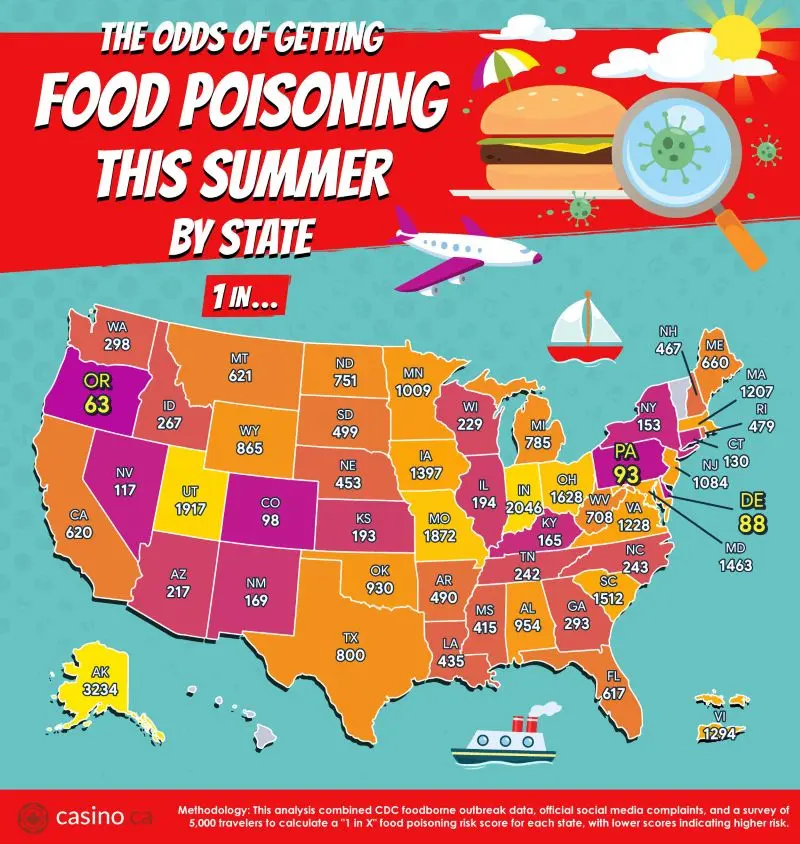
Claiming the unfortunate title of America's food poisoning capital is Oregon, where travelers face the highest odds of getting sick this summer. The state recorded more than 67,000 food poisoning-related incidents across official outbreak reports and restaurant outbreaks, working out at roughly one incident for every 63 residents. While Oregon is famous for its farm-to-table dining, craft breweries, and foodie culture, visitors may want to make sure they're packing more than just an appetite.
Next up is Delaware, where approximately one food poisoning incident is recorded for every 88 residents. Despite being one of America's smaller states, Delaware racked up more than 11,500 food poisoning reports, proving that size isn't everything when it comes to stomach troubles. The state also generated 354 social media complaints relating to foodborne illness, while 5% of travelers surveyed said they'd experienced food poisoning during a visit.
Taking third place is Pennsylvania, with approximately one food poisoning incident for every 93 residents. While tourists flock to the state for its rich history, vibrant cities, and famous cheesesteaks, the data reveals a less appetizing record. Pennsylvania has recorded more than 120,000 foodborne illnesses over the past 50 years - the highest total of any state analyzed. Adding to its concerning ranking, 3.4% of the 3,000 travelers on top of that surveyed reported experiencing food poisoning while visiting the state.
Just missing out on a podium finish is none other than The Centennial State, Colorado, where travelers face odds of around one food poisoning incident for every 98 residents. Whether you're hitting the ski slopes, mountain trails, or brewery scene, it may be worth keeping an eye on what's on your plate as well as the scenery.
Rounding out the top five is Nevada, with approximately one food poisoning incident for every 117 residents. Over the past 50 years, the Silver State has recorded more than 28,000 foodborne illness reports. Home to Las Vegas and its endless buffets, celebrity restaurants, and all-you-can-eat dining experiences, Nevada's ranking is a reminder that the biggest gamble in Vegas isn't always at the casino.
The States Where Travelers Face the Lowest Risk
At the opposite end of the rankings sits Alaska, where travelers face the lowest odds of experiencing food poisoning. Ranking as the state least likely to leave travelers with an upset stomach, Alaska recorded just one food poisoning incident for every 3,234 residents - significantly lower than anywhere else in the study.
Coming in as the second-safest destination is Indiana, with approximately one incident per 2,046 residents, followed by Utah (1 per 1,917), Missouri (1 per 1,872), and Ohio (1 per 1,628).
While no destination is completely immune to foodborne illness, these states appear to offer travelers a much lower chance of their vacation being interrupted by an unwelcome travel companion of food poisoning.
What Are the National Odds?
Across all states analyzed, more than 1 million food poisoning-related incidents were identified through official outbreak records, consumer complaints, and traveler survey responses.
Based on the findings, the average American faces approximately a 1 in 319 chance of being associated with a recorded food poisoning incident.
Summary
From Oregon to Nevada, the data shows that some destinations are far more likely to leave travelers reaching for stomach remedies than others. So before diving into that must-try restaurant or famous local delicacy, it might be worth checking a few reviews first.
Methodology
To identify the U.S. states where travelers face the highest risk of food poisoning, we analyzed foodborne outbreak data from the CDC's National Outbreak Reporting System (NORS), focusing on illnesses, hospitalizations, and deaths linked to restaurants and other food service establishments.
The analysis was supplemented with official social media complaints relating to food poisoning and food safety concerns, as well as a survey of 3,000 travelers exploring experiences toward foodborne illness while traveling.
We then compared the total number of recorded incidents against population estimates from the U.S. Census Bureau, producing a "1 in X" figure. Lower figures indicate a higher relative risk of food poisoning.
Data collected June 2026.
 We are 100% independent