
We're 100% independent
Find the top Canadian online casinos
Get the biggest welcome bonuses
We're 100% independent
Find the top Canadian online casinos
Get the biggest welcome bonuses
Forget lucky charms, the real St. Patrick’s Day flex might just be geography. A four-leaf clover shows up in roughly 1 in every 5,000 clovers, but depending on where you live, your odds of ever spotting one can vary wildly.
From the misty Pacific Northwest to the pasture-heavy Upper Midwest, certain states offer prime clover real estate, the kind where a casual stroll could turn into a once-in-a-lifetime find. However, in others, you’d probably have better luck stumbling across a needle in a haystack.
While luck may be random, opportunity isn’t. To see how Americans’ chances stack up, we surveyed 5,000 U.S. adults on where and how often they’ve spotted these tiny charms, and whether they believe they bring good fortune.
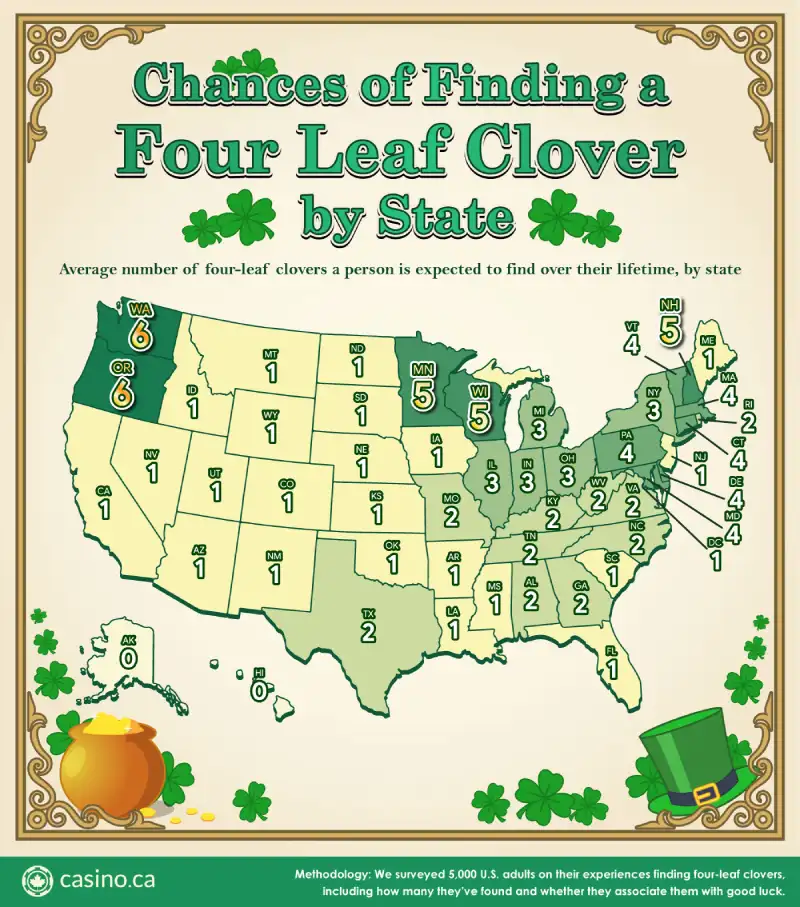
We crunched the numbers to see where Americans are most, and least, likely to stumble across one of nature’s rarest charms. Here’s the state-by-state breakdown.
At the top of the list are Washington and Oregon, the #1 states to find a four-leaf clover. The average person might spot 6 over a lifetime (roughly 7.5% chance per year), a rare but realistic jackpot thanks to endless lawns, parks, and rainy springs. Walk through a field in these states, and you might just stumble into a patch that feels like nature’s own lottery.
In 2nd place, Minnesota, Wisconsin, and New Hampshire aren’t far behind, with an average of 5 finds each. While still rare, the abundance of pastures, farmland, and suburban lawns gives regular walkers far better odds over time. In practical terms, that works out to roughly one lucky discovery every 15 years or so, making casual strolls through these green spaces a steady opportunity for a four-leaf clover sighting.
Rounding out the top 3, Maryland, Delaware, Pennsylvania, Massachusetts, Connecticut and Vermont average 4 finds per lifetime. While these states are smaller in size, they have plenty of lawns, parks, and clover-friendly areas, proving that it’s not how big a state is but how much usable green space it has that matters.
At the lowest end of the luck scale, four-leaf clovers are extremely rare. Alaska and Hawaii offer the slimmest odds, with limited clover-friendly areas and challenging conditions. For most residents, spotting even a single four-leaf clover over a lifetime is virtually impossible, with an average of 0 finds.
You don’t need to wander into the wilderness to find a four-leaf clover, your own backyard might be luckier than you think. Nearly half of people who have found a four-leaf clover (48%) report spotting one at home, with public parks (26%) and open fields (15%) not far behind. It seems nature’s rarest leaf prefers blending into everyday green spaces rather than hiding out in far-off meadows.
Luck often strikes when you least expect it. 55% of respondents weren’t actively hunting, while 45% were on a deliberate search. Maybe that’s why 57% believe a four-leaf clover brings good fortune, sometimes it’s the surprise that makes it lucky.
For some, the magic doesn’t end at discovery. Over 1 in 4 (26%) said something lucky happened after finding one, while 53% keep their clovers as mementos, most often pressed in a book (49%). And the charm can multiply: 24% say holding onto a leaf brought even more luck. Small as they are, these clovers make a lasting mark, proving that even the tiniest leaves can carry big impact.
Even in states where your chances are higher, finding a four-leaf clover is still a rare treat. From backyards to open fields, these little green gems reward patience and a keen eye. Whether you spot one by chance or on purpose, it’s a reminder that a touch of St. Patrick’s Day magic can show up when you least expect it.
We surveyed 5,000 U.S. adults about their experiences finding four-leaf clovers, including how many they’ve found, where they found them, and whether they associate the discovery with good luck.
Feel free to use the data or visuals on this page for non-commercial purposes. Please be sure to include proper attribution linking back to this page to give credit to the authors.
Global Casino Association™
Casino.ca is part of Global Casino Association™, the world´s largest casino comparison network.
Gambling can be addictive, please play responsibly
Casino.ca or our recommended casinos adhere to the standards set by these leading authorities



Mailing address:
1918 St. Regis Blvd
Montreal, Dorval, QC
H9P 1H6
Copyright © 2012 - 2026 Casino.ca | All rights reserved


