Chances of Surviving an Alien Invasion, By State
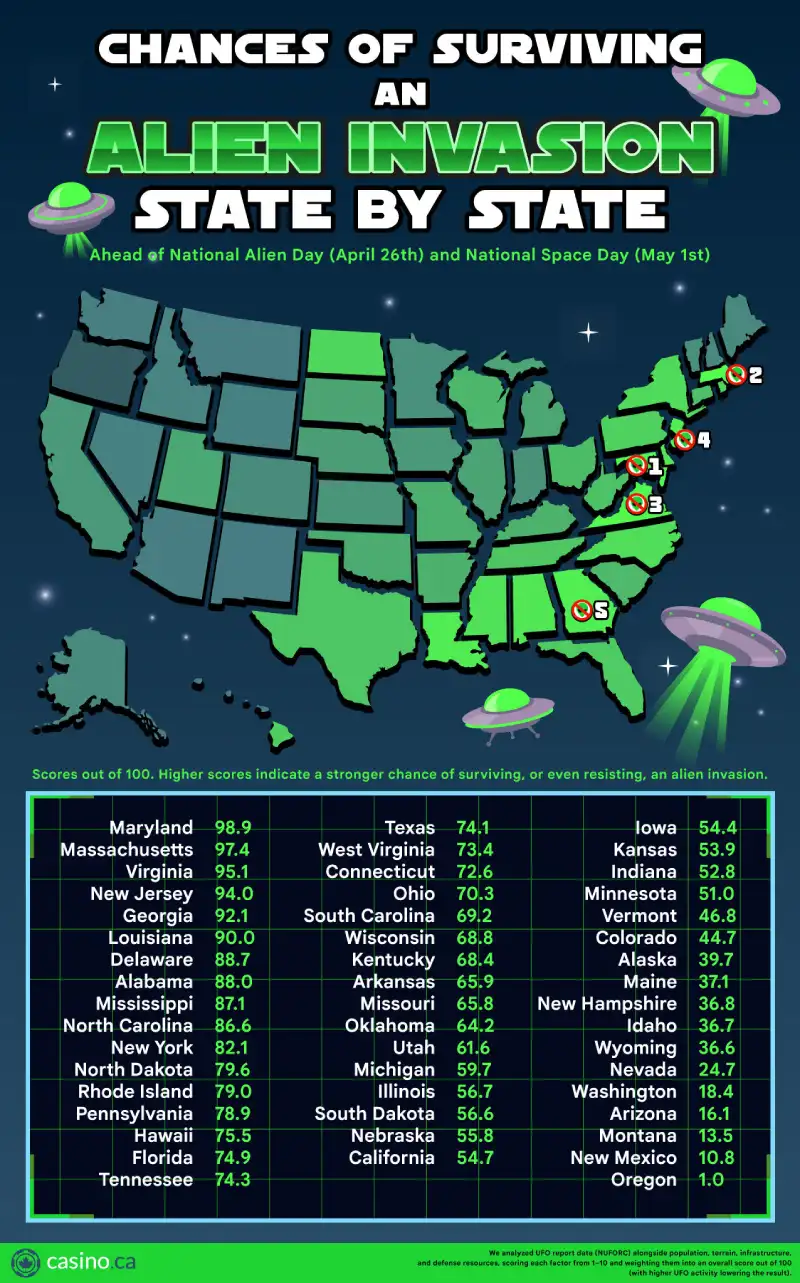
If aliens landed tomorrow, would your state survive… or be first in line for abduction? We crunched the numbers, and it turns out where you live could make all the difference. This National Alien Day (April 26th) and National Space Day (May 1st), we ranked all 50 U.S. states using our brand-new, data-driven Alien Invasion Survivability Index to reveal which states are ready to fight back and which might be waving a white flag at the mothership.
Our “Survivability Score” blends UFO activity, population density, natural terrain, and local defense and emergency resources to estimate how well a state could handle an extraterrestrial showdown. In other words, it’s a data-driven way to see which states are most likely to dodge laser fire… and which might get an unexpected ride off-planet first.
How the Index Works
The Alien Invasion Survivability Index scores states based on the following factors, weighted by importance (higher = better):
- UFO Reports (lower is better): 28%
- Water Coastal, Police, Military, National Guard, Emergency Preparedness: 7% each
- Population Density, Rural/Urban: 6% each
- Forest, Great Lakes, Area Ruggedness, Road Ruggedness: 5% each
- Total Population, Water Inland: 3% each
Key Findings:
- Top Defender: Maryland is the best-equipped state to survive an alien invasion
- Close behind are Massachusetts, Virginia, New Jersey, and Georgia reinforcing a broader pattern that East Coast states tend to be better prepared for an alien encounter
- Least Defender: Oregon is the most at-risk state if aliens arrive
- Other states that could be first on the aliens’ itinerary include Montana, New Mexico, Arizona, and Washington
Alien-Proofed States
1. Maryland (Alien Invasion Survivability Index Score - 98.9/100)
Maryland takes the top spot as the state most likely to survive an alien invasion, scoring 98.9/100 on the Alien Invasion Survivability Index. Leading the charge is standout emergency preparedness (34.4%), backed by a strong population base (13.0%) and solid military and National Guard presence (6.9% each). Inland water access (6.5%) adds a natural line of defence, while low UFO activity (6.4%) means it’s not exactly top of the aliens’ hit list. Put it all together, and Maryland looks less like an easy target and more like a state ready to give any alien visitors a serious run for their money.
2. Massachusetts (97.4/100)
Massachusetts takes 2nd place, proving that when it comes to surviving an alien invasion, smart planning goes a long way. Its strength is led by emergency preparedness (24.0%), with a large population (15.9%) helping it respond quickly. Road ruggedness (8.8%) could slow things down for any unwelcome visitors, while low UFO activity (7.4%) means it’s stayed under the radar, literally and figuratively. Add in inland water access (7.3%), and Massachusetts has the right mix of organisation, speed, and subtle advantages to make any alien arrival a tricky one.
3. Virginia (95.1/100)
Virginia takes 3rd place, where nature and preparedness team up to make it anything but an easy landing zone for an alien invasion. Its score is led by emergency preparedness (27.2%), followed by total population (11.9%), with inland water access (7.3%) adding natural barriers that complicate any approach. Military presence (5.3%) and National Guard strength (5.4%) round out the defence, reinforcing the state’s ability to respond quickly and effectively. With forests, rivers, and layered terrain working in its favour, Virginia is anything but a “welcome mat” for aliens.
4. New Jersey (94/100)
New Jersey takes 4th place, showing that being small can still pack a serious punch in an alien invasion. It leads with emergency preparedness (15.3%), supported by a dense population (12.5%) that makes coordination fast and efficient. Inland water access (6.1%) adds a few natural hurdles for any unwanted arrivals, while military (4.4%) and National Guard presence (4.4%) provide steady backup. Compact, well-connected, and quick to respond, New Jersey is well-positioned to respond before an invasion even has time to spread.
5. Georgia (92.1/100)
Georgia takes 5th place, where size and geography combine to create a surprisingly strong defensive profile against an alien invasion. Its ranking is led by emergency preparedness (28.3%), by far the dominant factor, supported by National Guard strength (6.3%) and military presence (5.8%). Total population (9.7%) adds scale and coordination capacity, while road ruggedness (5.8%) introduces enough complexity to slow movement across the state. With forests, rivers, and wide-open terrain working in its favour, Georgia is built to respond fast, and think big, if anything arrives from above.
Other Southern and Mid-Atlantic states - Louisiana (90), Delaware (88.7), Alabama (88), Mississippi (87.1) and North Carolina (86.6) - round out the top 10. Plenty of forests, rivers, and ready-to-roll response teams prove these states are not easy pickings.
Most at Risk When Aliens Arrive
At the opposite end of the spectrum, Oregon (1/10) ranks as the least prepared state for an alien invasion, yet paradoxically the most “on the radar.” UFO reports dominate its profile, accounting for 77.9% of the total score and making it the single defining factor in the entire index. Beyond that, forest cover (5.2%), road ruggedness (5.0%), and area ruggedness (4.1%) provide only modest structural layers, while National Guard presence (2.5%) adds limited additional support. Everything else combined contributes just 5.25%, leaving little meaningful influence outside the top drivers. Overall, Oregon stands out as a clear outlier: heavily defined by UFO activity, with relatively limited defensive or environmental factors to balance its exposure.
Other western states - Washington (18.4), Arizona (16.1), Montana (13.5), and New Mexico (10.8) - also score low. With wide-open spaces, low population density, and stretched emergency coverage, it’s almost like the aliens arrive with VIP parking already sorted - no queues, no stress, just straight in.
Conclusion
Some states are ready to put up a fight, while others might be better off ducking for cover and hoping the aliens skip their stop. The Alien Invasion Survivability Index shows just how much geography, population, and preparedness can shape the outcome of first contact, deciding who stands tall on Earth and who might end up taking an unplanned trip somewhere far, far away.
Methodology
We analyzed state-level data to estimate survival likelihood in a hypothetical alien invasion. UFO sighting data from the National UFO Reporting Center (NUFORC) was used to gather invasion likelihood.
Each variable (as listed above) was standardized and scored from 1–10. Scores were weighted based on their relative importance, and a weighted total was calculated for each state.
The final score is the sum of all weighted factors, minus the weighted UFO report score, and is presented out of 100. Higher scores indicate a greater likelihood of survival.
Fair Use
Feel free to use the data or visuals on this page for non-commercial purposes. Please be sure to include proper attribution linking back to this page to give credit to the authors.
 We are 100% independent