
We're 100% independent
Find the top Canadian online casinos
Get the biggest welcome bonuses
We're 100% independent
Find the top Canadian online casinos
Get the biggest welcome bonuses
With Super Bowl LX landing on February 8 at Levi’s Stadium, the excitement is building, and so is the price shock. Face-value tickets now run from $950 to $8,500, while resale prices on sites like StubHub and Vivid Seats have climbed as high as $63,099, and that’s before grabbing a beer or splurging on a VIP package.
Hard to believe, but it wasn’t always this pricey. Since the first Super Bowl kicked off in 1967, the average ticket price has exploded by 7,519%, turning what was once a fan-friendly day out into a full-blown financial commitment.
So, which Super Bowl stadiums have been the toughest on fans’ wallets? We crunched inflation-adjusted numbers across every still-standing host stadium, factoring in the cost of a ticket, a cold 16oz beer, a hot dog, parking, and a nearby hotel stay, to rank venues from budget-burners to (slightly) easier on the wallet.
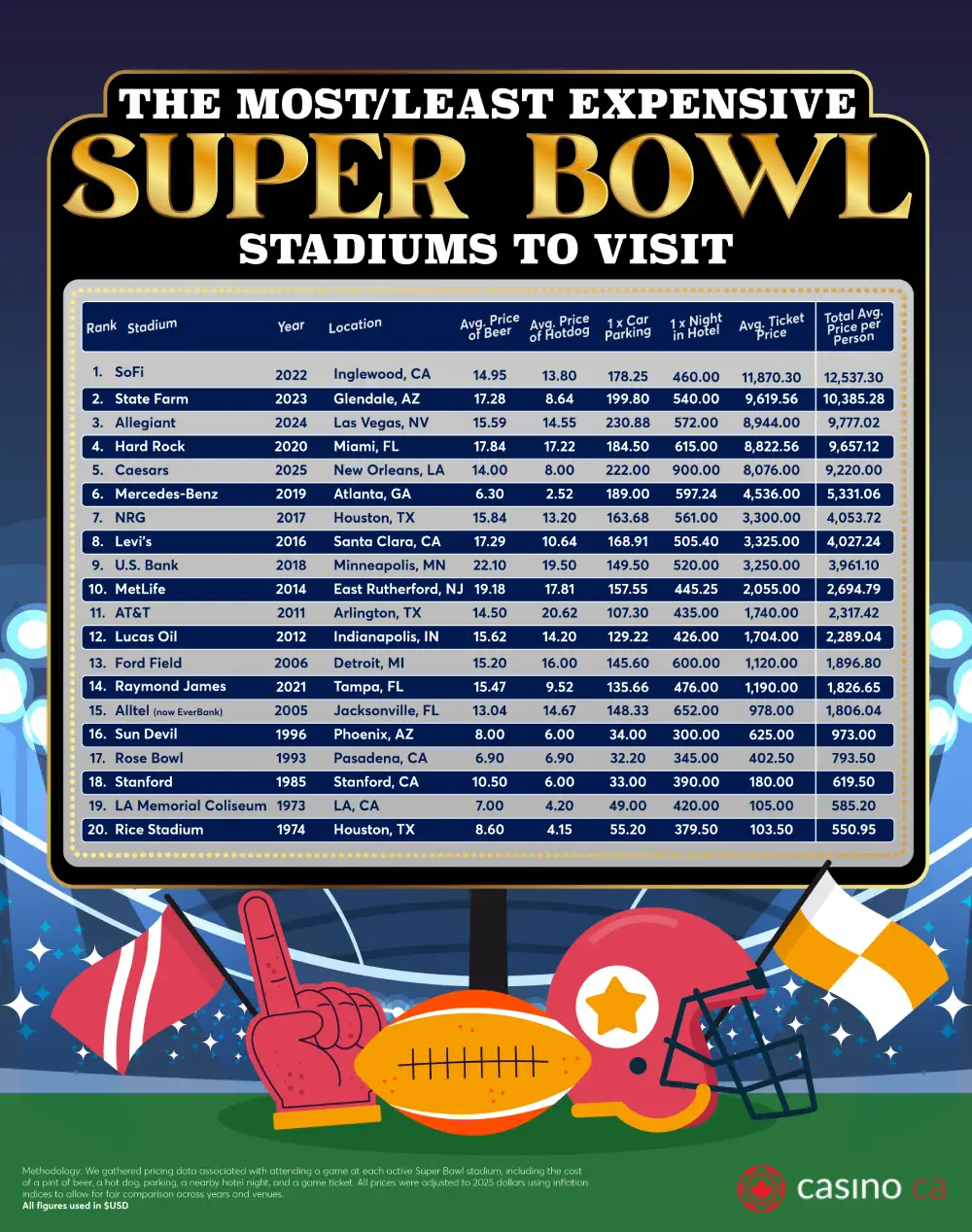
By crunching historical pricing data from every Super Bowl stadium, we added up the cost of the essentials: one 16oz beer, a hot dog, parking, a one-night hotel stay within three miles, and the average ticket price. All figures were adjusted for inflation to reflect what fans would be paying in today’s dollars.
Leading the rankings is SoFi Stadium in Inglewood, California, officially the most expensive Super Bowl stadium for fans, with an average total spend of $12,537 per person. Planning to stay nearby? Even a budget hotel will cost around $460 per night. But the biggest hit to the wallet is the ticket itself: SoFi has the highest average Super Bowl ticket price on record at $11,970, a jaw-dropping 11,367.9% increase compared to the most affordable Super Bowl ever held at Rice Stadium in 1974.
Next up is State Farm Stadium in Glendale, Arizona, host of Super Bowl LVII (2023), where the average fan spend comes in at $10,385. A cold beer to calm the nerves won’t be cheap either, averaging $17.28, placing it in the top 20% of most expensive stadium beers. Parking adds another sting, with an average spot costing $199.80, the third-most expensive overall and 47% higher than average.
Close behind is Allegiant Stadium in Las Vegas, which hosted in 2024 and fully lives up to its reputation. Parking here is the most expensive of any Super Bowl stadium, at $230.88, that’s $95.20 more than average (75%) just to leave your car. Add in a $572 budget hotel, a $15.59 beer, and the total average fan spend lands at $9,777.
Picture this: you’ve battled the ticket queues, you’re surrounded by buzzing fans, and there’s only one thing on your mind: a nice, cold beer. Across the 20 Super Bowl stadiums analyzed, the average price of a 16oz beer comes in at $13.76. But that buzz quickly fades at U.S. Bank Stadium in Minnesota (2018), where fans were shelling out a whopping $22.10 for a Bud Light, that’s $8.34 more than average, or 61% higher.
Not far behind is MetLife Stadium in New Jersey, host of Super Bowl XLVIII (2014), which still ranks as the second-most expensive beer even after inflation, at $19.18. Hard Rock Stadium follows close behind, charging $17.84 per beer when it hosted in 2020.
If cheap beers are non-negotiable, Mercedes-Benz Stadium in Atlanta is the clear winner. When it hosted in 2019, fans could grab a beer for just $6.30 (less than half the overall average). The Rose Bowl in Pasadena, which last hosted in 1993, isn’t far off either, with inflation-adjusted beer prices sitting at $6.90. Rounding out the bargain list is Los Angeles Memorial Coliseum (1973), where a beer would cost just $7.00 in today’s money, a dream scenario for thirsty fans.
If stadium food is the highlight of your game-day experience, some Super Bowl fans were in for a rude awakening. Across the stadiums analyzed, the average price of a hot dog sits at $11.41, but that average goes out the window at AT&T Stadium in Texas, host of the 2011 Super Bowl. Fans there were paying a painful $20.62 per hot dog, which is $9.21 more than average, a hefty 81% increase for one classic bite.
Close behind is U.S. Bank Stadium, which hosted in 2018 and charged $19.50, while MetLife Stadium, host of Super Bowl XLVIII (2014), rounds out the top three at $17.81 per hot dog.
Thankfully, not every stadium went full gourmet pricing. Mercedes-Benz Stadium in Atlanta, which hosted in 2019, led the way for bargain hunters with a famously fan-friendly $2.52 hot dog. Also easy on the wallet were Rice Stadium (1974) at $4.15 and the Los Angeles Memorial Coliseum (1973), where a hot dog would cost just $4.20 in today’s money.
To calculate parking costs, we analyzed multiple sources and created a blended average across official, premium, private, and offsite parking options for Super Bowl Sunday.
Planning to drive? Allegiant Stadium made that decision painful in 2024, charging a staggering $230.88 per parking spot, that’s 70% higher than average. Caesars Superdome followed closely at $222, while State Farm Stadium rounded out the top three at nearly $200 per spot, or $64 more than average. Suddenly, that Uber doesn’t sound so bad.
At the other end of the spectrum, the Rose Bowl kept things refreshingly cheap when it hosted in 1993, with parking costing just $32.20 (inflation-adjusted), a massive 76% below average. Stanford Stadium ($33) and Sun Devil Stadium ($34) weren’t far behind.
To estimate hotel costs, we looked at budget hotels (2* or higher) within three miles of each stadium, averaging prices across four nearby hotels to get a fair one-night rate.
Across all stadiums, the average hotel cost comes in at $506.97 per night. Sitting firmly at the top of the price pile is the Caesars Superdome, the most recent Super Bowl host, where nearby hotels averaged a painful $900 per night, that’s almost $400 more than average.
Next up is Alltel Stadium (now TIAA Bank Field), host in 2005, with average hotel prices of $652, followed by Hard Rock Stadium, which hosted in 2020, at $615.
Looking to save a little cash? Sun Devil Stadium, host of the 1996 Super Bowl, was the most budget-friendly, with nearby hotel stays averaging just $300 per night. $207 below the overall average.
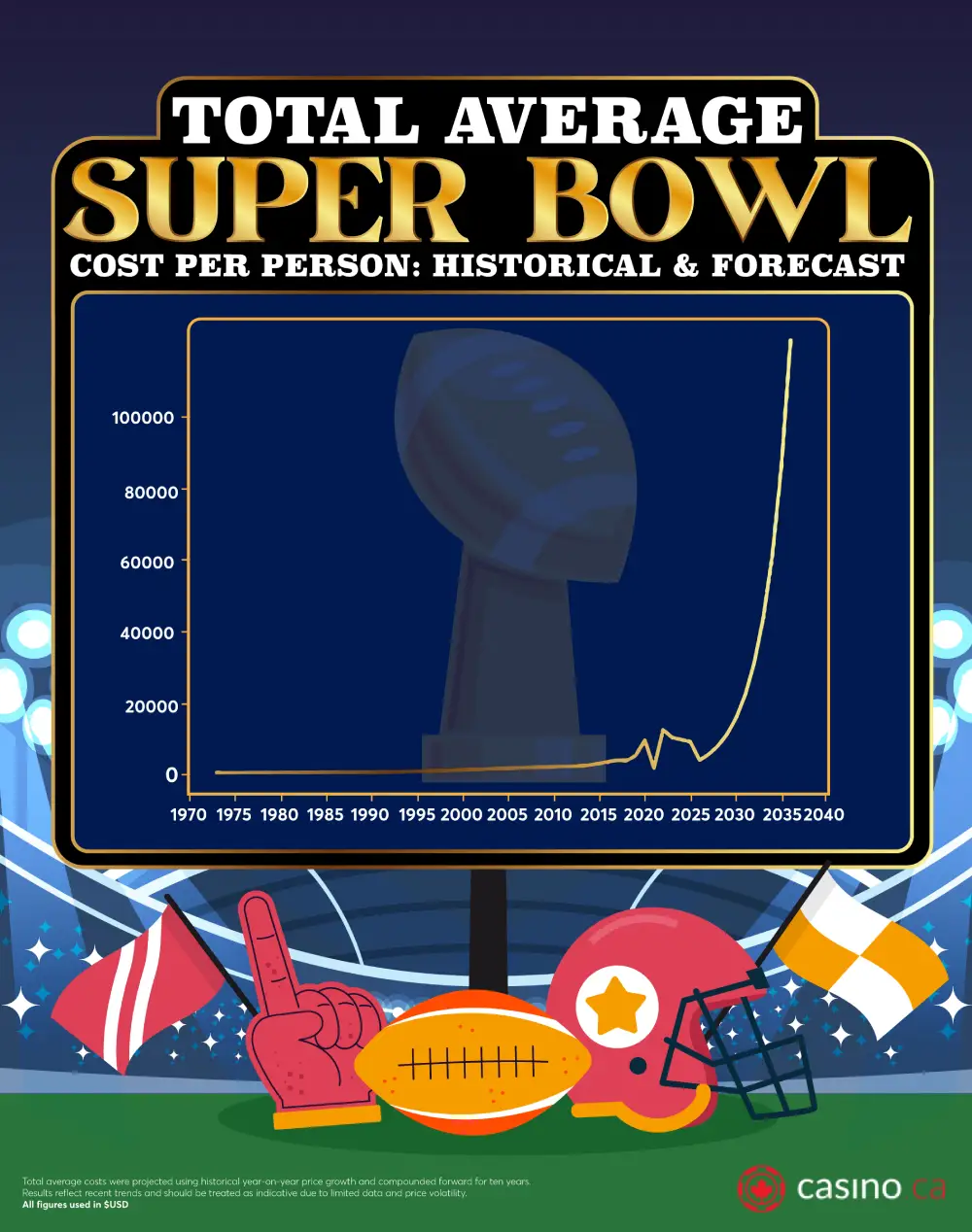
With Super Bowl costs already testing fans’ wallets, we used historical pricing data to project what attending the Big Game could look like over the next decade. Based on year-on-year trends and inflation, the numbers get eye-watering fast.
In 10 years’ time, the average beer could cost $64.79, a hot dog a staggering $307.08, parking $916.71, and a one-night hotel stay $845.03. And the real killer? If current trends continue, the average Super Bowl ticket price could reach $621,902 by 2036.
All told, that represents a 2,042.3% increase in the average cost per person. Might be time to start saving… now.
Data collected January 2026. Demolished or non-existent stadiums were excluded.
To ensure fair comparisons across years, all prices were adjusted to constant 2025 dollars using U.S. Consumer Price Index (CPI) inflation data. This removes distortions caused by inflation and reflects real cost differences over time.
Year-on-year percentage changes were calculated for each cost category, and average annual growth rates were used to project future costs. Due to volatility—especially in ticket prices, forecasts represent indicative trends, not precise predictions.
Average annual growth rates:
Forecasts were generated using 10 years of compound growth.
For media enquiries, please contact: admin@casino.ca
Feel free to use the data or visuals on this page for non-commercial purposes. Please be sure to include proper attribution linking back to this page to give credit to the authors.
Global Casino Association™
Casino.ca is part of Global Casino Association™, the world´s largest casino comparison network.
Gambling can be addictive, please play responsibly
Casino.ca or our recommended casinos adhere to the standards set by these leading authorities



Mailing address:
One Dundas Street West, Toronto, M5G 1Z3
Copyright © 2012 - 2026 Casino.ca | All rights reserved


